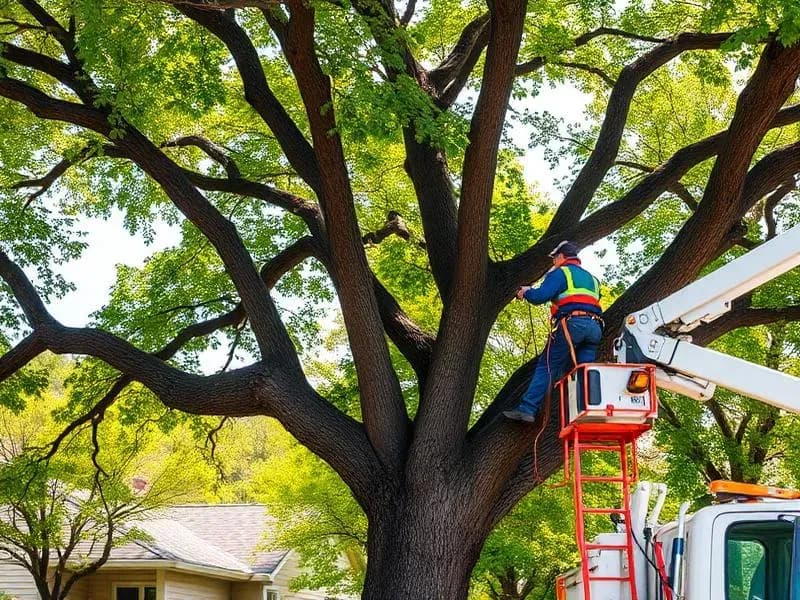
There is no single Massachusetts pruning date that fits every tree and shrub. Timing depends on the plant, its health, why a cut is needed, the size of the work, current pest or disease guidance, and weather conditions. Start with safety and plant identification before opening the tool box.
First question: is this homeowner-scale work?
UMass Extension's pruning safety guidance draws an important boundary around ladder work and tasks involving overhead hazards. Do not attempt pruning that requires a ladder, chainsaw aloft, work near utility lines, or control of a large or suspended limb. A qualified tree professional should assess those conditions.
Also pause when a tree is leaning, split, recently storm-damaged, decayed at the base, or dropping large branches. Timing advice is secondary to a site-specific hazard assessment.
Dead, broken, or hazardous branches
Dead or broken wood may need prompt attention rather than waiting for an ideal seasonal window. Keep people and property out of the drop zone and obtain qualified help when the work exceeds small, reachable hand-tool pruning.
For a small branch that can be cut safely from the ground, identify the branch collar—the swollen area where the branch joins a larger limb or trunk. The USDA Forest Service pruning guide explains why the final cut belongs just outside that collar.
Many deciduous trees: dormant-season evaluation
For many deciduous trees, dormancy offers a useful time to see the branch structure and plan selective cuts. That does not make late winter universally correct. Species, wound response, pest activity, tree condition, and the objective still matter.
Use dormant-season pruning for clearly defined goals such as removing a damaged branch, correcting crossing branches on a young tree, or improving structure. Avoid making large reductions simply because the canopy is easy to see.
Spring-flowering shrubs and small trees: usually after bloom
Many plants that flower early in spring formed their flower buds during the previous growing season. Pruning them before bloom can remove those buds. When flowering is the priority, pruning shortly after bloom often preserves the next display while leaving time for new growth.
Confirm the exact plant and whether it flowers on old or new wood. Hydrangeas are a common example of why a broad rule is risky: different groups respond to pruning at different times.
Summer-flowering shrubs: identify before cutting
Some shrubs that flower on the current season's growth can be pruned while dormant, but the plant's identity and desired form should control the decision. “Cut everything back in spring” is not a safe general prescription.
Evergreens: protect living growth
Evergreen pruning varies widely. Some plants can produce new growth from older wood; others may leave a permanent bare area if cut beyond green growth. Light shaping, candle management, hedge reduction, and the removal of a large evergreen limb are different operations. Verify species-specific guidance before proceeding.
Oak-wilt caution
The Massachusetts Division of Fisheries and Wildlife describes oak wilt as a serious emerging threat detected in neighboring states. That source does not support claiming that every fresh oak wound in Massachusetts is infected or that one fixed statewide calendar is the only safe rule.
Before pruning an oak, check current Massachusetts agency guidance and consult a qualified arboricultural professional about species, location, urgency, and current risk conditions. Do not rely on an undated internet calendar.
Make correct cuts
The USDA Forest Service recommends preserving the branch collar and avoiding both flush cuts and long stubs. For a branch with enough weight to tear bark, use a staged removal so the final cut is made without the branch peeling down the trunk.
Avoid topping. Removing the ends of major limbs indiscriminately damages structure and stimulates weakly attached growth. A reduction or clearance objective should be planned with appropriate lateral branches and the tree's future form in mind.
How much canopy can be removed?
A universal percentage is not a homeowner prescription. The tolerable amount depends on species, age, health, season, site stress, and the size and position of each branch. When the plan involves multiple live limbs or a major change in canopy, obtain a qualified assessment.
Pruning decision checklist
Before each cut, confirm:
- the plant is correctly identified;
- the reason for pruning is specific;
- the work is reachable from the ground with an appropriate hand tool;
- no utility line, suspended limb, decay, or unstable structure is involved;
- timing accounts for flowering and current pest or disease guidance;
- the branch collar and final cut location are visible;
- the cut will not become topping, a flush cut, or a stub.
Pruning debris can be part of a broader property cleanup, but a cleanup service is not evidence of tree-care credentials. The seasonal cleanup page can be used to discuss debris and property scope. Use the contact form to confirm the requested work, location, qualifications needed, and current availability.