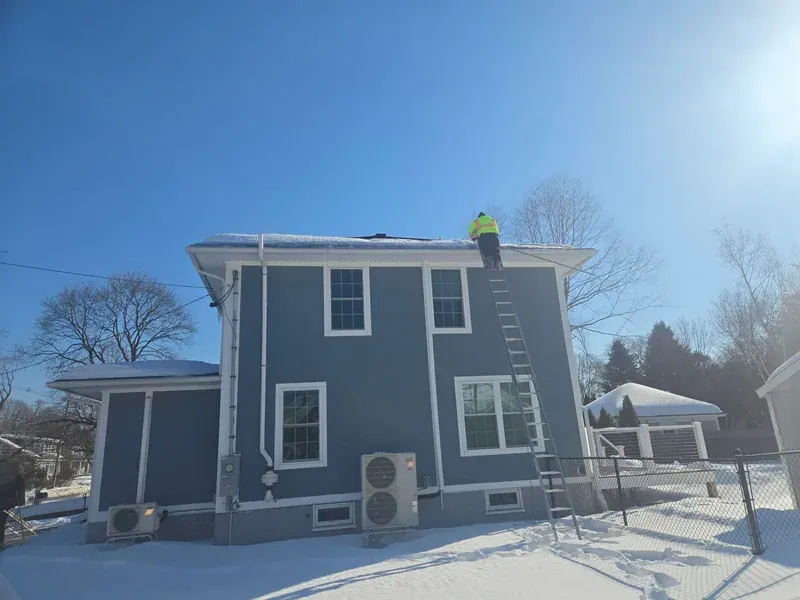
A useful snow removal quote is a description of work, not just a number. Two prices are not comparable until they define the same trigger, surfaces, storm conditions, return visits, ice treatment, documentation, and exclusions.
This article does not publish statewide “average” prices. No authoritative 2026 dataset in the research dossier supports the ranges that appeared in the legacy draft, and property-specific scope can change a quote substantially.
Begin with the property map
Measure and photograph every area that may be included:
- driveway and parking areas;
- public and private sidewalks;
- steps, ramps, entries, loading areas, and fire access;
- gates, narrow turns, slopes, low clearances, and parked-vehicle patterns;
- drainage structures and locations where snow can or cannot be stored;
- curbs, walls, plantings, irrigation components, and other edge hazards.
Identify who controls each surface. A public sidewalk, shared drive, tenant area, or municipal easement may involve obligations different from a private driveway.
Check legal and local responsibilities
The Massachusetts snow and ice law overview collects state cases and points readers to local bylaws. The Massachusetts Superior Court's premises-liability instruction explains that reasonable care depends on factors such as use, risk, and burden; it is not a universal contractor response standard.
The Massachusetts Office on Disability also explains the importance of maintaining accessible routes and checking the responsibilities that apply to a property.
This is general planning information, not legal advice. Check current municipal rules and obtain legal or accessibility guidance for the specific property when needed.
Define the trigger
The contract should explain what starts service. Questions include:
- Is the trigger based on measured accumulation, forecast, ice, drifting, or a customer request?
- Where and when is accumulation measured?
- Are mixed precipitation and repeated small events treated differently?
- What happens when a storm changes after service begins?
Do not assume that a common trigger in one proposal is a legal requirement or an industry-wide standard.
Define every included surface
List plowing, shoveling, blowing, deicing, snow relocation, hauling, and cleanup separately. Specify which walks, steps, ramps, doors, parking stalls, loading zones, hydrants, drains, dumpsters, and mailbox approaches are included.
For commercial or multifamily property, describe accessible routes and operating hours rather than relying on “all sidewalks” or “ADA areas” without a map.
Account for storm duration and return visits
A long event may require work during snowfall, after snowfall, or both. The quote should state:
- whether service occurs during an active storm;
- when a final pass is performed;
- how drifting, municipal plow berms, and vehicle movement are handled;
- whether return visits are included, triggered, or separately priced;
- how the customer requests an additional visit.
Avoid a promised response time unless it appears in the signed scope with definitions and exceptions.
Separate ice treatment from snow clearing
Plowing does not remove bonded ice. A proposal should identify the surfaces eligible for treatment, the trigger for application, the material or decision process, documentation, and whether follow-up is included.
Material choice has tradeoffs. UMass guidance on winter salts explains how spray, runoff, and soil accumulation can injure plants. Alternatives can still cause damage, so storage, application, runoff, pets, surfaces, and nearby landscaping all need review.
Compare contract structures
Per-event, per-visit, hourly, seasonal, and hybrid agreements allocate weather and scope risk differently. None is automatically cheaper.
Per-event or per-visit
Clarify the accumulation band, what counts as a new event or visit, and how multi-day storms and return work are billed.
Seasonal
Clarify the contract dates, total-accumulation or visit limits, trigger, included services, unusual-event provisions, and termination terms. Do not assume “seasonal” means unlimited work.
Time and materials
Clarify equipment and labor categories, minimums, mobilization, materials, documentation, and approval for extra work.
Require clear documentation
A useful written agreement identifies:
- property and service map;
- trigger and monitoring method;
- included and excluded surfaces;
- treatment materials and decision authority;
- storm and return-visit process;
- snow storage and hauling terms;
- price structure and change authorization;
- communication and recordkeeping;
- credentials or insurance the customer must verify;
- cancellation, suspension, and force-majeure terms.
Verify current references, registrations, insurance, and any credential required for the actual work. A website or city page is not proof of fleet size, dedicated routes, response time, or availability.
Request a property-specific estimate
The snow removal, ice control, and winterization pages provide topics for an estimate discussion. Use the contact form to provide the address and scope and to confirm whether the location and current availability are a fit. No fleet, route priority, guaranteed response, contract terms, or price is promised by this guide.