Ice Control
De-icing and anti-icing treatments to prevent dangerous ice buildup on walkways, driveways, and parking areas.
Get a free Ice Control estimate
Professional Ice Control Services

Prevent slips, falls, and accidents with professional ice control services from Monges Landscaping, serving residential and commercial properties throughout Boston, Cambridge, Newton, Brookline, Wellesley, and communities across Metro West and Worcester. Massachusetts winters bring not just snow but also freezing rain, sleet, black ice, and the persistent freeze-thaw cycles that create some of the most treacherous walking and driving conditions in the Northeast. In fact, ice-related slip-and-fall injuries send over 1 million Americans to emergency rooms annually, with Massachusetts consistently ranking among the highest-risk states. Professional ice control keeps your property safe for family, guests, employees, and customers while significantly reducing your exposure to costly liability claims.
Understanding ice formation in Massachusetts helps explain why professional management is necessary. Our winters produce ice through multiple mechanisms, and each requires a different response. Freezing rain occurs when rain falls through a subfreezing air layer near the surface, coating everything — walkways, driveways, steps, vehicles, and trees — with a sheet of clear, hard ice. This is the most dangerous icing event because the ice is transparent (making it hard to see), extremely slick, and bonds tightly to surfaces. Sleet (ice pellets) bounces on impact and accumulates like small ball bearings, creating a different type of hazard. Black ice forms when surface temperatures drop below freezing and moisture from melting snow, dew, or light mist freezes into an invisible, razor-thin ice layer on pavement — particularly dangerous on shaded surfaces in early morning. Refreeze happens when snow or ice melt during daytime temperatures above freezing and then refreezes overnight as temperatures drop again. In Massachusetts, refreeze is an almost daily occurrence from December through March, creating dangerous ice on surfaces that appeared clear just hours earlier. Frost formation occurs when surface temperatures drop below the dew point, depositing a thin but slippery ice crystal layer on walkways and steps.
Our ice management program uses a proven two-phase approach for maximum effectiveness: anti-icing (proactive treatment before ice forms) and de-icing (reactive treatment after ice has formed). This dual strategy is the industry standard practice recommended by the Snow and Ice Management Association (SIMA) and is far more effective than reactive-only approaches.
Anti-icing is the first and most important phase. Before a forecast freezing event, we apply liquid brine solution or granular products to pavement surfaces. These products lower the freezing point of any moisture that contacts the treated surface, preventing ice from ever bonding to the pavement. When ice cannot bond to the surface, it remains loose and is easily removed by plowing, shoveling, or even foot traffic. Anti-icing dramatically reduces the amount of ice that forms, makes subsequent clearing operations faster and more effective, reduces the total amount of de-icing product needed (which saves money and reduces environmental impact), and provides immediate safety improvement the moment precipitation begins. We typically apply anti-icing treatments 6-12 hours before the expected onset of freezing precipitation.
De-icing is the second phase, applied after ice has already formed on surfaces. De-icing products work by penetrating through the ice layer to the pavement surface below, breaking the bond between ice and pavement. Once the bond is broken, the ice sheet loosens and can be scraped, plowed, or shoveled away. De-icing is necessary when anti-icing was not possible (unexpected ice events), when ice has formed on untreated surfaces, or when the severity of the event overwhelms the anti-icing application.
Choosing the right ice control product is critical because different products work at different temperatures, have different environmental impacts, cost different amounts, and affect surfaces differently. Here is a detailed comparison of the products we use. Rock salt (sodium chloride) is the most widely used and most economical ice control product. It effectively melts ice down to approximately 15°F (-9°C). Below this temperature, rock salt becomes progressively less effective and is essentially inert below 0°F. Rock salt works by creating a brine solution when it contacts moisture, which has a lower freezing point than pure water. Application rates are typically 2-4 pounds per 100 square feet. The drawbacks of rock salt are that it can damage concrete (particularly new concrete less than one year old), harm vegetation when over-applied, and corrode metal. It is also harmful to freshwater ecosystems in high concentrations. Despite these limitations, rock salt remains the standard product for most applications because of its low cost and effectiveness in typical Boston winter temperatures.
Calcium chloride is a premium product that works at much lower temperatures — down to -25°F (-32°C) — making it essential for the coldest days of Massachusetts winters. It is hygroscopic, meaning it attracts moisture from the air, which helps it start working immediately even on dry ice. Calcium chloride also generates heat as it dissolves (exothermic reaction), which accelerates ice melting. These properties make it the fastest-acting de-icer available. It is less damaging to vegetation than rock salt and is safe for concrete. The trade-off is cost — calcium chloride is approximately 3-5 times more expensive per pound than rock salt. We use it strategically for severe cold events and on surfaces where rock salt is not appropriate.
Magnesium chloride offers a middle ground between rock salt and calcium chloride. It is effective down to approximately 0°F (-18°C), is significantly gentler on concrete surfaces (it is the product most recommended by concrete industry associations for deicing), and causes less damage to vegetation and landscaping. It works relatively quickly and has a low toxicity profile. Magnesium chloride is our recommended product for concrete walkways, decorative pavers, and stamped concrete surfaces.
Sand and sand-salt mixtures do not melt ice but provide immediate traction on icy surfaces. Sand is the most environmentally friendly option and is appropriate for unpaved surfaces, areas near sensitive water features, and extremely cold conditions where chemical melters are ineffective. The drawback is that sand requires cleanup in spring (it can clog storm drains if not collected) and provides no melting action.
For environmentally sensitive areas — properties near freshwater bodies, wells, rain gardens, or areas heavily used by pets — we offer eco-friendly alternatives. Beet juice-enhanced brine is a pre-treatment solution that combines salt brine with beet juice extract. The sugar compounds in beet juice lower the effective temperature of the brine while reducing total salt usage by 30-40%. CMA (calcium magnesium acetate) is a biodegradable, non-corrosive ice control product originally developed for use on bridges and sensitive infrastructure. It is safe for concrete, vegetation, and waterways, though significantly more expensive than salt-based products. Potassium chloride-based products (like Safe Paw) are marketed as pet-safe and vegetation-friendly, making them popular for residential walkways and entrances where pets and children play.
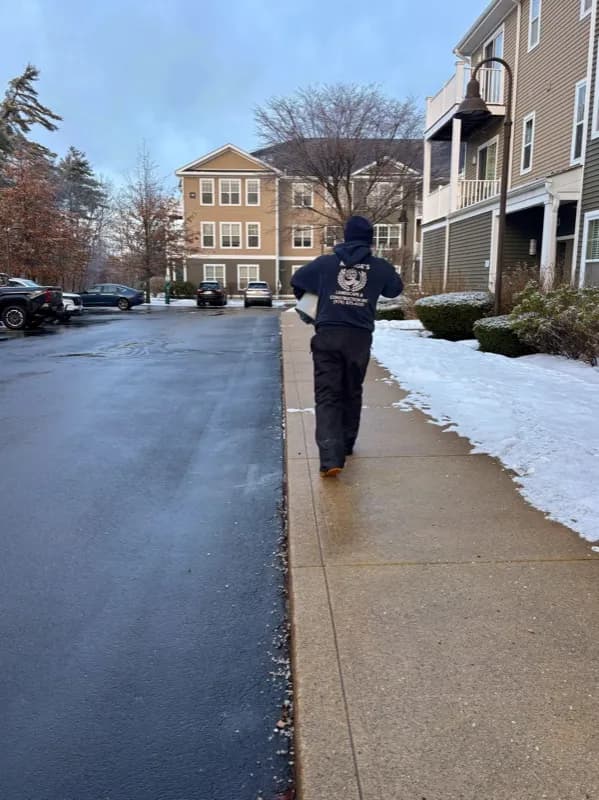
Application technique matters as much as product selection. Over-application wastes money, damages surfaces and vegetation, and harms the environment. Under-application leaves dangerous ice in place. Our technicians are trained in proper application rates based on the specific product, surface type, temperature, and precipitation type. We use calibrated spreaders (both vehicle-mounted for large areas and walk-behind for sidewalks and walkways) that deliver consistent, measured application rates. For liquid anti-icing, we use truck-mounted spray systems that apply brine at the precise rate of 30-50 gallons per lane-mile.
For commercial properties, our ice control services include detailed documentation of every application — date, time, product used, application rate, weather conditions, and surface conditions. This documentation creates a record of due diligence that is critical for defending against slip-and-fall liability claims. Massachusetts follows a "reasonable care" standard — property owners are not required to guarantee ice-free conditions, but they must demonstrate that they took reasonable steps to manage ice hazards. A well-documented professional ice management program is the strongest evidence of reasonable care.
We integrate ice control with our snow plowing and snow removal services for comprehensive winter property care. Most commercial and many residential clients include salt and sand application as part of their seasonal snow management contract, ensuring that every plowing visit concludes with surface treatment. Standalone ice control visits are also available for ice events that occur without snowfall (freezing rain, refreeze, frost). Residential ice control visits typically cost $75-$200 per application depending on driveway and walkway area. Commercial applications range from $150-$500+ per visit depending on lot size and product used. Contact Monges Landscaping at (978) 860-5474 for a free ice control estimate.
Ready for Professional Ice Control?
Get a free estimate today. We serve Boston, Metro West, and Worcester areas.
What We Offer
Benefits
What Our Clients Say
"Monges saved us during the big snowstorm! They showed up at 5am to clear our driveway before we had to leave for work. Truly reliable 24/7 service."
Robert Johnson
Homeowner
Related Services
Frequently Asked Questions

Ready to Transform Your Landscape?
Get a free consultation and quote today