Snow-covered landscape in Boston area - Monges Landscaping winter servicesAutumn foliage in Boston area - Monges Landscaping fall cleanup servicesLush green landscaping in Boston area - Monges Landscaping spring servicesLush green landscaping in Boston area - Monges Landscaping summer services
    Fall Services

    Leaf Removal

    Complete leaf removal and disposal services to keep your lawn healthy and your property looking pristine all fall long.

    Get a free Leaf Removal estimate

    Professional Leaf Removal Services

    Leaf Removal

    Don't let fallen leaves smother your lawn and damage your garden. Monges Landscaping provides comprehensive leaf removal services throughout Boston, Cambridge, Newton, Brookline, Wellesley, and the greater Metro West and Worcester areas during the fall season. Massachusetts is blessed — and challenged — by one of the most spectacular fall foliage displays in the country, courtesy of our abundant deciduous trees. Red and sugar maples, white and red oaks, American beeches, white birches, hickories, and ash trees create a canopy that turns brilliant shades of red, orange, gold, and crimson every autumn. But what goes up must come down, and the volume of leaves that fall on Boston-area properties between September and December is staggering. A single mature oak tree can drop 200,000-500,000 leaves per season. Professional removal is not optional for homeowners who want to maintain a healthy, attractive landscape.

    Understanding why leaf removal matters starts with what happens when leaves are left on your lawn. Within days of accumulating, a layer of fallen leaves begins blocking sunlight from reaching your grass. Cool-season grasses in Massachusetts need every available hour of fall sunlight to photosynthesize, build root reserves, and prepare for winter dormancy. A leaf blanket shuts down this process prematurely, weakening the lawn heading into winter. As leaves get wet from rain and dew, they mat together into a dense, suffocating layer that traps moisture against the grass surface. This creates ideal conditions for fungal diseases — particularly snow mold (both gray and pink varieties), which develops under wet cover during fall and winter and is not visible until spring when the snow melts, revealing dead, matted patches of grass. Brown patch, dollar spot, and red thread are other fungal diseases promoted by leaf-covered lawns. Beyond disease, wet leaves create a physical barrier that prevents air circulation, traps heat, and attracts pests seeking winter shelter — voles, mice, and insects all nest in leaf layers.

    Leaves in garden beds pose their own problems. While a thin layer of chopped leaves can serve as mulch, whole leaves piled on perennial crowns trap moisture and promote crown rot, which kills the plant from the center. Leaves piled against shrub bases create similar moisture problems and harbor rodents that chew on bark over winter. Ground covers can be completely smothered by heavy leaf accumulations.

    Leaves on walkways, driveways, and steps are safety hazards. Wet leaves are extremely slippery — comparable to ice in terms of fall risk. Homeowners are liable for slip-and-fall injuries on their property, making leaf removal from walking surfaces a risk management issue, not just an aesthetic one. Leaves clogging gutters cause water damage and ice dams in winter, as we discuss in detail on our gutter cleaning page.

    Different tree species present different leaf removal challenges, and understanding your trees helps you plan your fall strategy. Maples are among the first to drop, typically peaking in mid to late October. Their large, flat leaves mat together quickly and decompose relatively fast. Birches drop small leaves that filter into every crevice and are difficult to blow from garden beds. Beeches hold many of their leaves through winter on lower branches, creating a slow, extended drop that continues into spring. Oaks are the most challenging species for leaf removal because they hold their leaves significantly longer than other trees — red oaks may not finish dropping until late November or December. Oak leaves are also tough and leathery, decomposing much more slowly than maple leaves. Properties with large oaks require the longest leaf removal season and the most persistent attention.

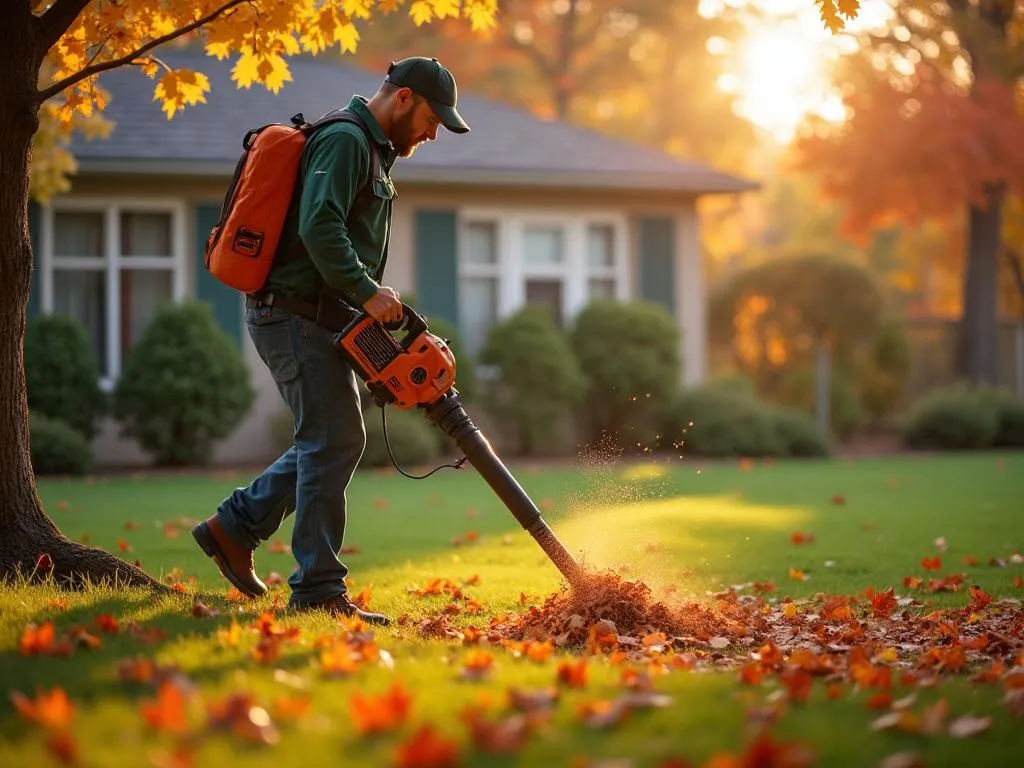
    Our leaf removal crews use a systematic approach with professional-grade equipment for fast, thorough results. We work in teams of 2-4 depending on property size. The process starts at the edges — blowing leaves from garden beds, fence lines, foundation plantings, corners, and tight spaces outward onto open lawn areas using commercial backpack blowers rated at 500-700 CFM (cubic feet per minute). These professional blowers move 3-5 times the air volume of consumer models, dramatically reducing the time needed to clear complex landscape areas.

    Once leaves are consolidated on lawn areas, we use walk-behind blowers or large ground-force blowers to push them into collection rows or piles. For final pickup, we employ truck-mounted leaf vacuum systems that suction leaves directly into our enclosed trailer through a large-diameter hose. This method is fast, clean, and thorough — no tarps full of leaves blowing around, no raking, and no mess left behind. We haul all collected leaves to commercial composting facilities for environmentally responsible disposal.

    For very large properties or properties with extraordinary leaf volume, we supplement vacuum collection with tarp and drag systems. Large tarps are spread, filled with leaves using blowers, and dragged to the curbside or collection area for vacuum pickup. This combination of techniques allows us to process very high volumes efficiently.

    We offer flexible service options designed to fit different property needs and budgets. One-time fall cleanup is ideal for homeowners who handle leaves themselves during the season but want their property professionally cleaned after peak leaf drop. We typically schedule these in late November after the majority of deciduous trees (except oaks) have finished dropping. Our crew arrives, clears every surface — lawn, beds, walkways, driveways, porches, patios — and hauls everything away, leaving your property clean heading into winter.

    Weekly leaf removal service is our most popular option for properties with significant tree coverage. Our crews visit on a set schedule (typically the same day each week) from mid-October through early December, keeping your property continuously clean throughout the fall season. Weekly service prevents leaf accumulation from ever reaching damaging levels, keeps walkways safe at all times, and ensures your lawn stays healthy through the critical fall period. For properties heavily shaded by oaks, we extend weekly service through the end of December if needed.

    Bi-weekly service is a cost-effective middle ground for properties with moderate leaf volume. We visit every two weeks during the fall season, which is sufficient to prevent serious accumulation on most properties with a mix of tree species.

    We also offer leaf mulching as an alternative to full removal. Using commercial mulching mowers, we shred leaves into fine pieces directly on the lawn. These tiny leaf particles filter down between grass blades and decompose rapidly, returning valuable nutrients (nitrogen, phosphorus, potassium, and trace minerals) to the soil. Studies from Michigan State University and other universities have shown that mulching up to 6 inches of leaves into a lawn over the season provides measurable soil improvement with no negative effect on grass health. Leaf mulching is appropriate for moderate leaf coverage but is not effective for heavy accumulations that would smother grass even when mulched.

    Common leaf removal mistakes homeowners make include waiting until all leaves have fallen before doing any removal (by then, the leaves underneath have been killing grass for weeks), using a mulching mower on heavy, wet leaves (which clumps and smothers rather than mulching effectively), blowing leaves into the street (which is prohibited in many Massachusetts communities and clogs storm drains), and raking aggressively on saturated soil (which damages grass roots). Our professional crews avoid all these issues with proper equipment, techniques, and timing.

    Most residential leaf removal visits cost $150-$400 depending on property size, tree coverage, and leaf volume. Weekly service plans run $100-$250 per visit. Full-season weekly packages (6-8 visits) typically run $600-$1,500 for the entire season. One-time fall cleanups for average-sized residential properties run $300-$600. We provide exact pricing after an on-site assessment. Contact Monges Landscaping at (978) 860-5474 for a free fall leaf removal estimate.

    Licensed & Insured
    10+ Years Experience
    5-Star Rated
    Free Estimates

    Ready for Professional Leaf Removal?

    Get a free estimate today. We serve Boston, Metro West, and Worcester areas.

    What We Offer

    01
    Lawn Leaf Removal
    02
    Leaf Blowing
    03
    Bagging & Disposal
    04
    Weekly Service
    05
    One-time Cleanup
    06
    Garden Bed Clearing

    Benefits

    Prevents lawn disease
    Maintains curb appeal
    Reduces pest habitat
    Prepares lawn for winter

    What Our Clients Say

    Leaf Removal

    "Our property has over 20 large oak trees. Monges leaf removal service is a lifesaver! They come weekly during peak fall and our yard always looks immaculate."

    J

    Jennifer Adams

    Homeowner

    FAQ

    Frequently Asked Questions

    Stone patio walkway

    Ready to Transform Your Landscape?

    Get a free consultation and quote today